
From the weight room to the weekly shop, here are the habits that matter for hormonal health and how to put them into practice.

You’ve got three workouts in the diary. By the third, you’re running on five hours of sleep and a lunch you ate in a rush. That evening you find yourself Googling “how to increase testosterone”. To feel more energised for your next session, start with a healthy dinner and try going to bed half an hour earlier.
Those habits are the basis for our sample week, with three weights sessions, one cardio session, time to recover and three day menus to mix and match. We also look at where our Testo Complex can fit in and what the Zinc and vitamins we chose for the formula do.
When lifestyle can make a difference
Testosterone is a hormone involved in sexual function, body composition and bone health. In adult men, levels vary throughout the day and can be affected by illness, medication or conditions such as obesity. Context matters, including how you feel and when the blood sample was taken. Endocrine Society.
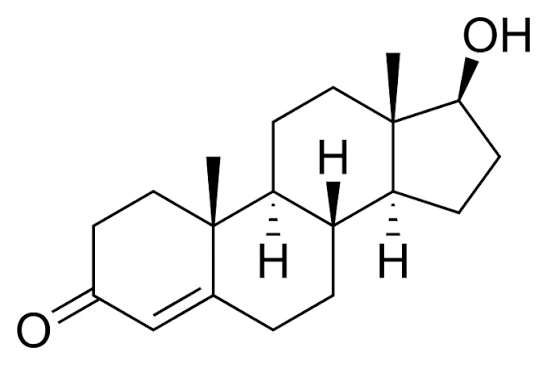
If you live with obesity, sustainable weight loss can help improve testosterone levels, particularly when low levels are related to obesity. Set a goal that fits your situation and start with changes you can keep up even on your busiest weeks. European Association of Urology guidelines.
If you train a lot and eat too little, you may need a different approach. If you eat less than you need to fuel your training for several weeks, you may recover more slowly and notice a drop in sexual desire. Your bone health can also be affected. The International Olympic Committee describes this pattern in male athletes as well. Pay attention to falling performance and persistent fatigue, especially during a period of restrictive eating or after increasing your training load. International Olympic Committee consensus.
How to train for muscle growth

Training well means finding a rhythm that lets you make progress and recover between sessions. Start with weights you can control and try adding one rep or a little weight each week to build up gradually. Regular exercise is one of the habits that support hormonal health. If obesity is contributing to low testosterone, combining regular physical activity with weight loss can help improve those levels. European Association of Urology guidelines.
Main lifts and accessory exercises in one workout
Squats, flat bench presses and deadlifts are a good starting point for a programme. Put them first, while you’re fresh and able to focus on technique. Add a military press for overhead work, an incline bench press to vary the angle and a single-leg exercise like walking lunges or Bulgarian split squats. Lat pulldowns, leg curls and cable rows round out the programme. ACSM resistance training guidelines.


Three days of weights across the week
Take Monday, Wednesday and Friday as an example. Move them around your commitments, leaving a day between weights sessions where possible. Do a few warm-up sets before your working sets of squats, presses and deadlifts. If you’re getting back into training, start with two sets per exercise and finish with two or three good reps in reserve. ACSM guidelines.
Day 1 · Squat and flat bench press
| Exercise | Sets | Reps | Rest |
|---|---|---|---|
| Barbell squat | 3 | 6–8 | 2–3 min |
| Barbell flat bench press | 3 | 6–8 | 2–3 min |
| Low cable row | 2 | 8–12 | 90–120 s |
| Machine leg curl | 2 | 10–15 | 60–90 s |
| Dumbbell curl (biceps) | 2 | 10–12 | 60–90 s |
| Rope cable pushdown (triceps) | 2 | 10–15 | 60–90 s |
| Front plank (abs) | 2 | Hold 20–40 s | 45–60 s |
Day 2 · Deadlift and military press
| Exercise | Sets | Reps | Rest |
|---|---|---|---|
| Barbell deadlift | 2 | 5–6 | 2–3 min |
| Barbell military press | 3 | 6–10 | 2–3 min |
| Lat pulldown | 2 | 8–12 | 90–120 s |
| Walking lunge | 2 | 8–10 per leg | 90–120 s |
| Dumbbell hammer curl (biceps) | 2 | 10–12 | 60–90 s |
| Overhead cable extension (triceps) | 2 | 10–15 | 60–90 s |
| Dead bug (abs) | 2 | 6–10 per side | 45–60 s |
Day 3 · Incline bench press and Bulgarian split squat
| Exercise | Sets | Reps | Rest |
|---|---|---|---|
| Dumbbell incline bench press | 3 | 8–12 | 90–120 s |
| Dumbbell Bulgarian split squat | 2 | 8–10 per leg | 90–120 s |
| Machine row | 2 | 8–12 | 90–120 s |
| Cable face pull | 2 | 12–15 | 60–90 s |
| Low cable curl (biceps) | 2 | 10–12 | 60–90 s |
| Cable triceps extension | 2 | 10–15 | 60–90 s |
| Reverse crunch (abs) | 2 | 10–15 | 45–60 s |
Leave arm and ab work until the end of the session. Keep your pelvis steady and breathe during planks and dead bugs. The rest times are guidelines. Take longer if you need to perform the next set well, especially on the main lifts. Once you reach the top of the rep range on every set with good form, gradually increase the weight on loaded exercises.
One cardio session and time to recover

If you lift on Monday, Wednesday and Friday, try cardio on Saturday. Do 25–35 minutes of brisk walking, cycling or swimming at a pace that lets you talk. Count any match or tough sports session you already have planned as part of your weekly load. Leave Tuesday, Thursday and Sunday for rest or light movement, depending on how you feel.
For general health, the WHO recommends 150–300 minutes of moderate aerobic activity per week for adults, or the equivalent at higher intensity, plus strength work on at least two days. If you’re starting from a low activity level, build up gradually. A brisk walk after lunch or walking part of your commute can add minutes across the week. WHO.
How much rest do you need?
Some days the weights feel heavier. If it happens for several sessions and you’re also sleeping worse, look at what has changed outside the gym. Perhaps you’ve picked up extra shifts, skipped meals or added a Friday football match. Try cutting a few sets or taking an evening off and see how you recover. If fatigue persists, talk to a healthcare professional. International Olympic Committee consensus.
Make sleep part of the programme

For adults aged 18 to 60, the American Academy of Sleep Medicine and the Sleep Research Society recommend at least seven hours of sleep regularly. Sleep quality matters too. Studies of total sleep deprivation have observed reductions in testosterone, while findings on short-term partial sleep restriction are less consistent. A good sleep routine helps recovery even when hormone levels are already within the normal range. Sleep consensus, Review of sleep and testosterone.
If your alarm goes off at seven, work backwards and allow time to fall asleep. Keep similar hours each day, dim the lights near bedtime and have your last coffee or caffeinated pre-workout earlier if you struggle to fall asleep. An easy walk or a few pages of a book can help you wind down. If you snore loudly, someone notices pauses in your breathing or you often feel sleepy during the day, ask your doctor about possible sleep apnoea. NIH tips for healthy sleep, NIH sleep apnoea symptoms.
What to eat to support training and recovery

Start with a plate of rice, chicken and courgettes with a drizzle of olive oil. You can vary it the next day with rice or bread for carbohydrates, chicken or pulses for protein, seasonal vegetables and extra virgin olive oil. Adjust the portions to how active you are, what you want to achieve and how hungry you are by the next meal. CREA dietary guidelines.
- Protein for muscle. Rotate fish, eggs, plain yoghurt, lean meat, pulses and tofu. For healthy adults lifting to gain muscle, about 1.6 g of protein per kg of body weight per day is a practical reference from a meta-analysis. At 75 kg, that works out to roughly 120 g of protein across the day’s meals. This figure relates to muscle growth. Morton and colleagues’ meta-analysis.
- Carbohydrates for exercise. Use oats, pasta, bread, rice, potatoes, pulses and fruit. Choose between wholegrain and refined cereals according to the meal and how well you tolerate them. If you train after work and lunch was hours ago, try a snack such as yoghurt and a banana or bread and ricotta. CREA dietary guidelines, International Olympic Committee consensus.
- Fats from varied sources. Use mostly extra virgin olive oil. Rotate nuts, seeds and fish such as sardines or mackerel during the week. Eggs, fish and dairy can all fit into a varied diet. CREA dietary guidelines.
Vary your micronutrient intake by rotating sources of Zinc during the week. Shellfish, meat, pulses and pumpkin seeds are some options. CREA dietary guidelines.
Junk food and processed foods to cut back on
If you have a sugary drink at every lunch or open a bag of crisps whenever you get home late, you’ve found a place to start. Keep water, fruit or yoghurt handy and save soft drinks, packaged cakes, processed meats, fried foods and fast food for when you really fancy them. In a controlled NIH study, participants ate more and gained weight during the phase high in ultra-processed foods. The study measured energy intake and body weight. Italian dietary guidelines advise drinking as little alcohol as possible. NIH study, CREA dietary guidelines.
At the supermarket, look for what helps you put together a meal. Tinned chickpeas, plain frozen vegetables and plain yoghurt are processed and can all make a good shop easier. For a quick dinner, try rinsed chickpeas, sautéed frozen vegetables, wholemeal bread and extra virgin olive oil. Tofu is another option. A meta-analysis of clinical trials found no decline in total or free testosterone in men consuming soy or isoflavones. CREA dietary guidelines, Meta-analysis of soy and hormones.
Three sample day menus to mix and match
Take lunch from one column and dinner from another. These are examples for healthy adults, and portions should reflect your needs. Have a snack when it helps, for instance if you train after work and had lunch hours earlier.
| Meal | Weights day | Active recovery day | Vegetarian day |
|---|---|---|---|
| Breakfast | Plain Greek yoghurt, oats, banana and walnuts | Eggs, wholemeal bread and an orange | Plain skyr, no-added-sugar muesli and a pear |
| Lunch | Rice, chicken, courgettes and extra virgin olive oil | Pasta and chickpeas with seasonal salad | Spelt, lentils, roasted vegetables and extra virgin olive oil |
| Snack | Bread and ricotta before training | Plain yoghurt and fruit if you’re hungry | Hummus, wholemeal bread and carrots |
| Dinner | Baked salmon, potatoes and broccoli | Spinach frittata, wholemeal bread and tomatoes | Stir-fried tofu, rice and seasonal vegetables |
The CREA gives 80 g of dry rice and 200 g of potatoes as standard portions. You can use these figures for lunch and dinner in the first column and adjust them to your needs. If you train a lot, you may need more at lunch. If you eat dinner soon after training and have eaten enough during the day, a smaller snack may do. CREA standard portions.
If you’re trying to gain muscle and find it hard to eat enough, add a serving of rice, bread or potatoes to a meal, or a more substantial snack. If your aim is to lose weight, look at caloric drinks, frequent snacks and habitual second helpings, while keeping protein, vegetables and carbohydrates in your meals. To plan ahead, cook two grains, a tray of vegetables and a pot of pulses. Then switch up the dressings and protein sources during the week. CREA dietary guidelines.
Where our Testo Complex fits into your routine
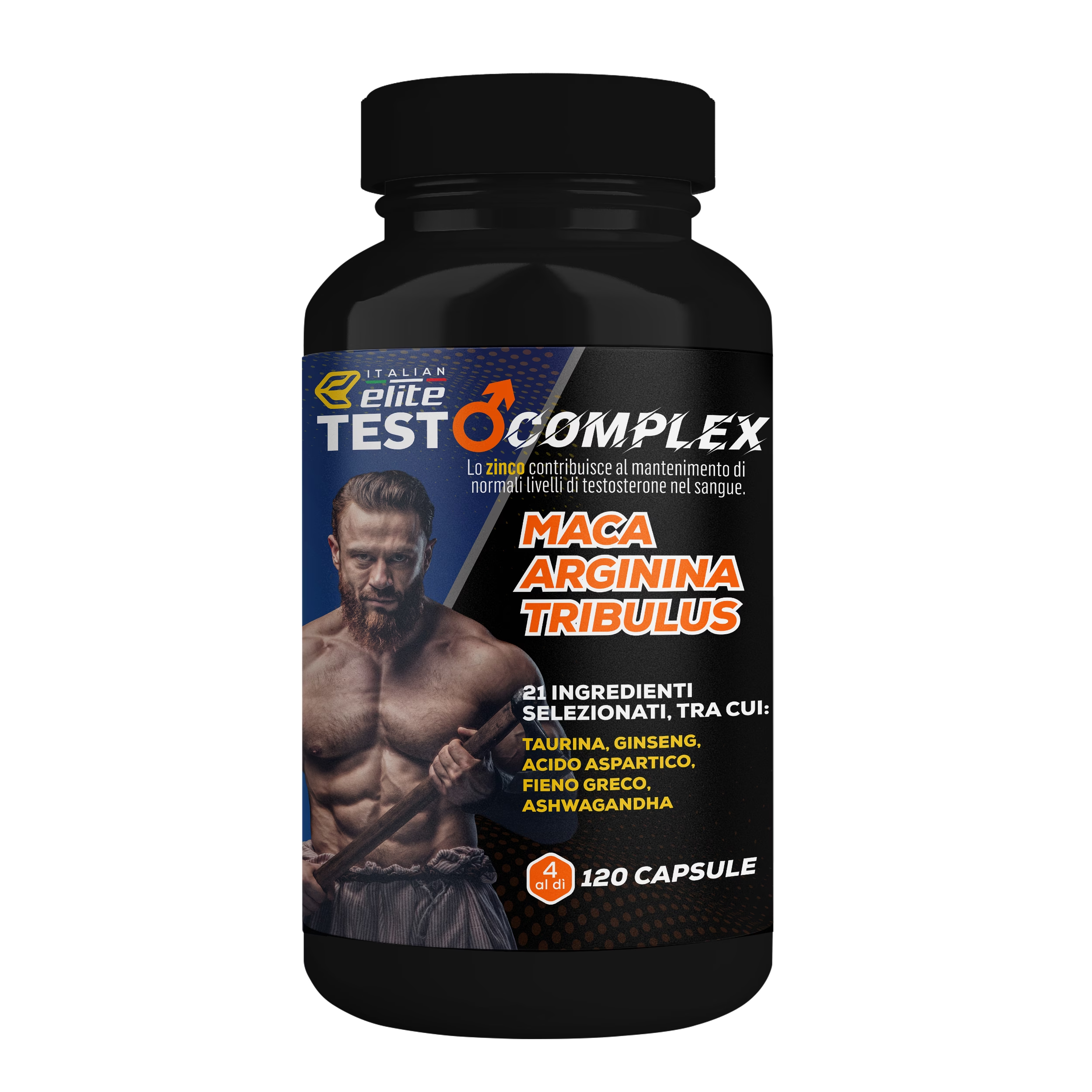
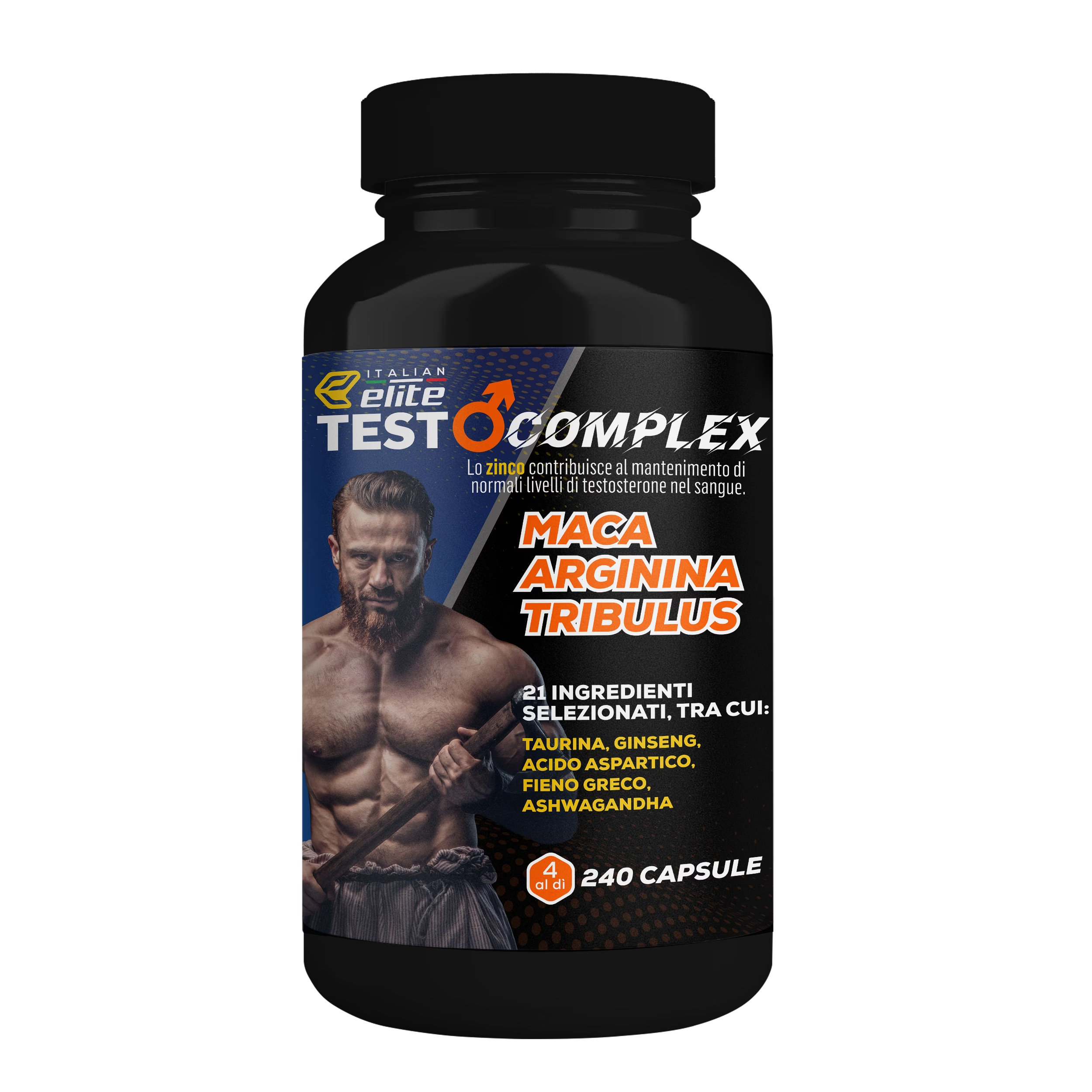
Once training, meals and sleep have a place in your week, supplements can fit into that routine too. Our Testo Complex brings together 21 ingredients, including Zinc, vitamins and botanical extracts such as Maca and Tribulus terrestris.
The role of Zinc and vitamins in testosterone
Four capsules of our Testo Complex provide 10 mg of Zinc, or 100% of the nutrient reference value (NRV). This mineral contributes to the maintenance of normal testosterone levels in the blood. One small study illustrates why intake matters. Testosterone fell when dietary Zinc was restricted and increased after supplementation in a group of older men with insufficient intake. EU regulation on authorised claims, study of Zinc and testosterone.
The formula also contains Vitamin B6, which contributes to the regulation of hormonal activity, and Vitamin B5, which contributes to the normal synthesis and metabolism of steroid hormones. Testosterone is one of these hormones. EU regulation on authorised claims.
In a study of men who had just started lifting weights, the group taking a specific Ashwagandha extract recorded an increase in blood testosterone compared with placebo after eight weeks. Ashwagandha study.
Energy and attention at work and in the gym
If you head to the gym after work, consider how your body uses the energy it gets from food. Vitamin B5, for example, is needed to make coenzyme A, which helps cells use fats and other nutrients. In our Testo Complex, Vitamin B5, Vitamin B6, Vitamin B12 and Vitamin C contribute to normal energy metabolism and help reduce tiredness and fatigue. NIH Vitamin B5 fact sheet, EU regulation on authorised claims.
During work that demands attention, these nutrients have different roles. Zinc contributes to normal cognitive function and Vitamin B5 contributes to normal mental performance. For people who train, Vitamin D3 contributes to maintaining normal muscle function. Like Vitamin K1, it also contributes to maintaining normal bones. EU regulation on authorised claims.
Sexual desire, Maca and Tribulus terrestris saponins
Maca has been studied for its potential effect on sexual desire. In a small controlled trial, men taking a specific Maca preparation reported greater desire from week eight. Blood testosterone was similar to the placebo group. It’s an example of how desire and hormone levels can change independently. Maca study.
A study of Tribulus terrestris in men with erectile difficulties also found improved answers about sexual desire after twelve weeks. Researchers used a saponin-standardised extract, prepared to contain a defined amount of these plant compounds. The outcome measured the effect of the whole extract. Tribulus terrestris study.
The 21 ingredients in the formula
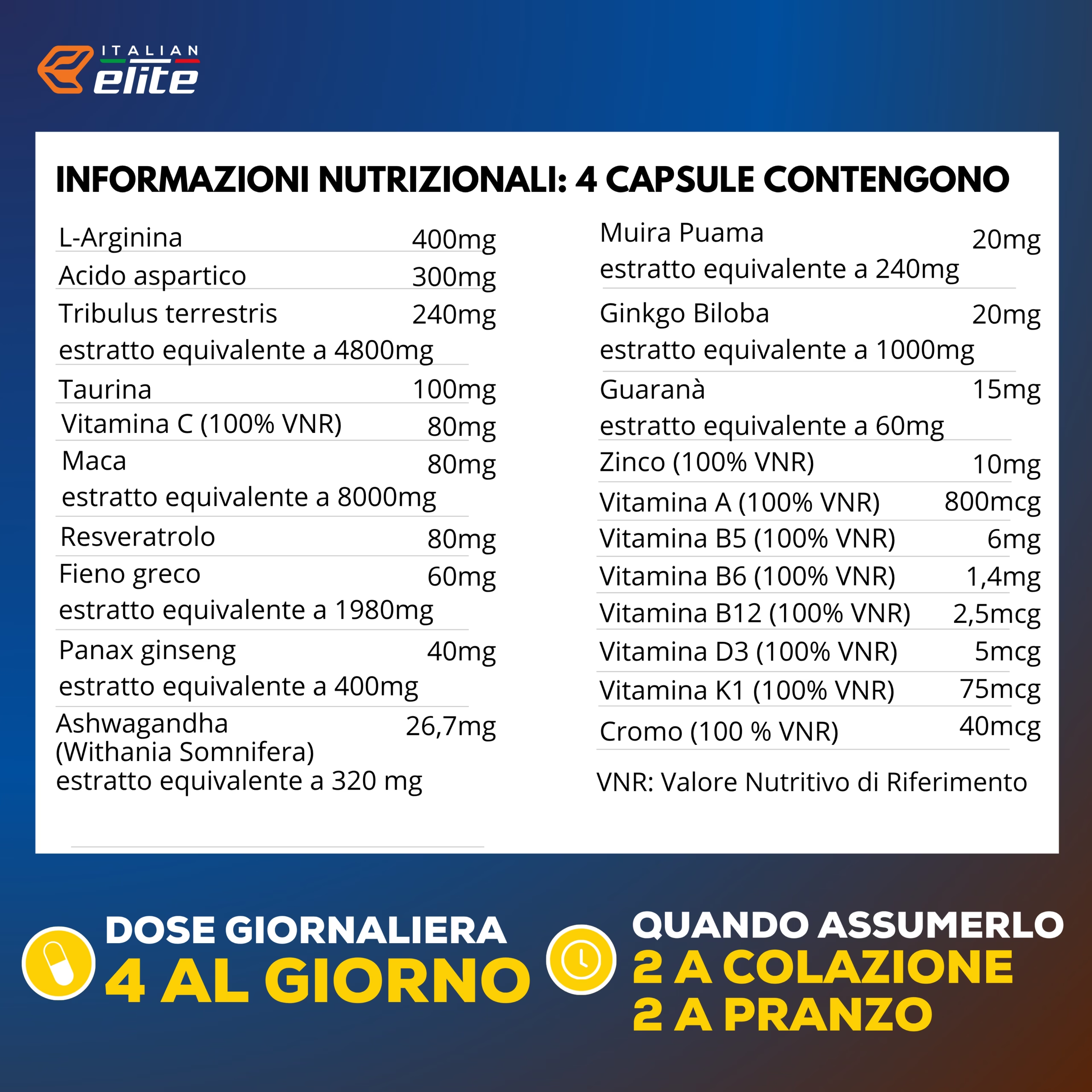
Here’s what four capsules provide. The botanical amounts below are weights of the extracts. The image also shows the corresponding plant equivalents.
- Botanical extracts. Tribulus terrestris 240 mg, Maca 80 mg, Fenugreek 60 mg, Panax ginseng 40 mg, Ashwagandha 26.7 mg, Muira puama 20 mg, Ginkgo biloba 20 mg and Guarana 15 mg.
- Other ingredients. L-Arginine 400 mg, Aspartic acid 300 mg, Taurine 100 mg and Resveratrol 80 mg.
- Vitamins. Vitamin C 80 mg, Vitamin A 800 µg, Vitamin B5 6 mg, Vitamin B6 1.4 mg, Vitamin B12 2.5 µg, Vitamin D3 5 µg and Vitamin K1 75 µg. Each provides 100% of the NRV.
- Minerals. Zinc 10 mg and Chromium 40 µg, both at 100% of the NRV.
Pack sizes and where to buy
We offer Testo Complex in 120- and 240-capsule packs, which last 30 and 60 days respectively at the labelled dose of two capsules at breakfast and two at lunch. We sell it on our website and through Amazon. The product page lets you choose your pack in our shop or follow the Amazon link. See the Testo Complex product page on Italian Elite.
When to get your testosterone checked
If you notice persistently low desire, fewer spontaneous erections on waking, erectile difficulties or fertility problems, speak to a doctor. Ongoing fatigue is worth discussing too, as it can have many causes. A diagnosis of hypogonadism takes both symptoms and testosterone values into account. Testing usually starts with total testosterone in the morning while fasting, then a second sample on a different day if the first result is low. If you and your partner are trying to conceive, discuss this before any testosterone therapy, which can reduce sperm production. Endocrine Society, European Association of Urology.
Where to start
Aim for at least three weights sessions a week. On days off, find time when you can for an easy jog or a brisk walk. Eat a varied, healthy diet, with meals that provide enough energy to train, and make room for sleep. That’s how you build consistency, week after week.
If you want to add a supplement to this routine, you can pair it with our Testo Complex. After a month, look through your training diary. See how many workouts you managed, how you’re sleeping and how much energy you have left for the last set. Use that to decide which habits to keep and where to take the next step.